> ## Documentation Index
> Fetch the complete documentation index at: https://docs.idun-group.com/llms.txt
> Use this file to discover all available pages before exploring further.
# MCP Servers
> Extend your agent with external tool servers using the Model Context Protocol.
Idun Engine uses the [Model Context Protocol (MCP)](https://modelcontextprotocol.io) to extend agent capabilities with external tools. You declare MCP servers in your `config.yaml` (or through the admin panel at `/admin/mcp/`), and the engine discovers every advertised tool at boot.
The [langgraph-tool-local template](/templates) shows how to mix local tools with MCP tools in a single agent.
## How it works
1. **Register MCP servers** in the admin panel or YAML config with transport settings and connection details
2. **The engine discovers tools** from each configured MCP server at startup
3. **Agents invoke tools** during conversations as needed, with results passed back for response generation
The standalone runs a single agent per process, so every MCP server registered in the config (or admin panel) is available to that agent.
## Transport types
MCP servers connect to the engine through one of four transport protocols:
| Transport | Use case | Required fields |
| ----------------- | -------------------------------------------- | ----------------- |
| `stdio` | Local processes, Docker containers | `command`, `args` |
| `sse` | Remote servers with Server-Sent Events | `url` |
| `streamable_http` | Remote servers with HTTP streaming (default) | `url` |
| `websocket` | Persistent bidirectional connections | `url` |
The transport is decided by the MCP server, not the client. Most hosted servers expose exactly one. For example, `https://mcp.data.gouv.fr/mcp` is `streamable_http` only, with no `sse` or `stdio` fallback. Check the server's documentation before picking a transport; mismatched values fail at the handshake, not the YAML schema.
## Configuration example
Define MCP servers in your `config.yaml` or through the admin panel:
```yaml config.yaml theme={"theme":{"light":"github-light","dark":"github-dark"}}
mcp_servers:
- name: fetch
transport: stdio
command: docker
args: ["run", "-i", "--rm", "mcp/fetch"]
- name: filesystem
transport: stdio
command: npx
args: ["-y", "@modelcontextprotocol/server-filesystem", "/data"]
env:
ALLOWED_DIRECTORY: /data
- name: custom-api
transport: streamable_http
url: https://mcp.example.com/api
headers:
Authorization: "Bearer ${MCP_API_TOKEN}"
```
Tools are discovered at engine boot and made available to your agent via `get_langchain_tools()` / `get_adk_tools()`.
Navigate to `/admin/mcp/` in the running standalone. The catalog at the top groups MCP servers by transport: Streamable HTTP, SSE, WebSocket, and stdio. Existing servers are listed below with their transport, endpoint, and status.
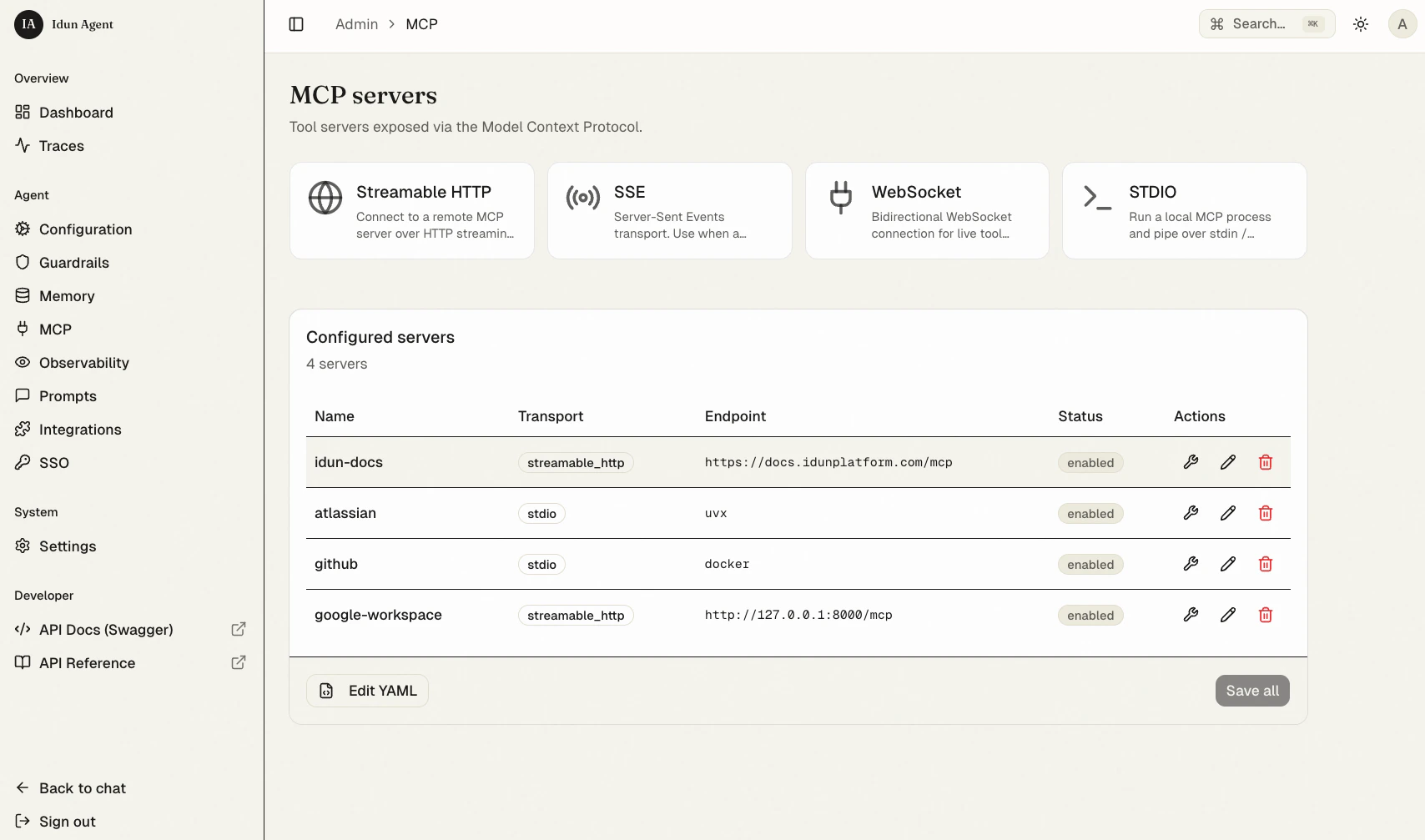 Click the transport card you want and fill in the form: a unique name, the URL (or command and args for stdio), optional headers. The **Enabled** toggle lets you keep a server configured but skipped at startup.
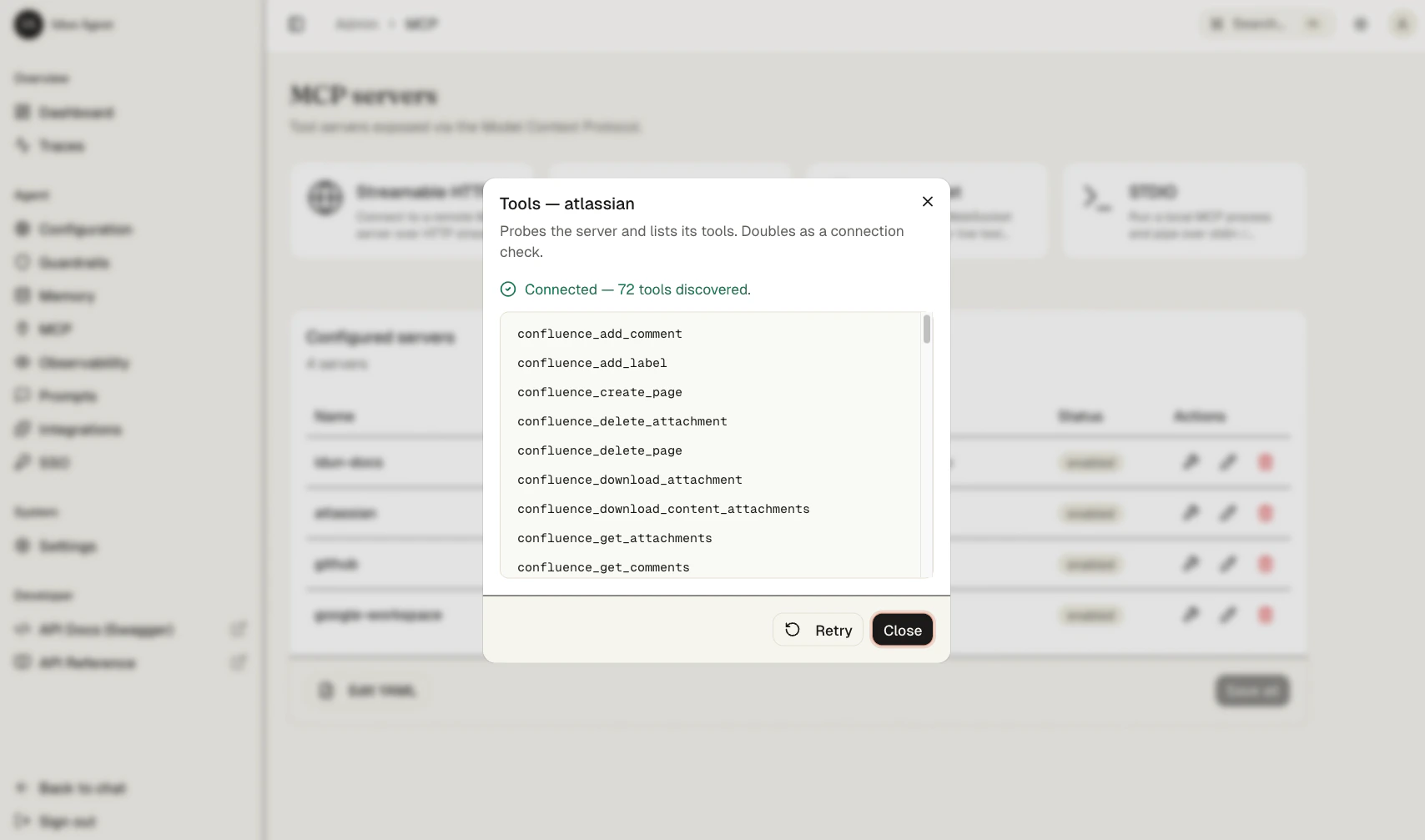
Save; the reload pipeline re-instantiates the engine with the new MCP registry. Click the wrench icon next to a server to probe it and list the tools it advertises. The probe doubles as a connection check.
Click the transport card you want and fill in the form: a unique name, the URL (or command and args for stdio), optional headers. The **Enabled** toggle lets you keep a server configured but skipped at startup.
Save; the reload pipeline re-instantiates the engine with the new MCP registry. Click the wrench icon next to a server to probe it and list the tools it advertises. The probe doubles as a connection check.
 ## Integration approaches
Pre-built MCP servers packaged as Docker containers. Pull, configure, and use without writing server code.
Host your own MCP servers for custom business logic, proprietary data sources, or internal APIs.
## Framework integration
The engine provides helper functions to load MCP tools into your agent code:
```python ADK theme={"theme":{"light":"github-light","dark":"github-dark"}}
from idun_agent_engine.mcp import get_adk_tools
idun_tools = get_adk_tools()
```
```python LangGraph theme={"theme":{"light":"github-light","dark":"github-dark"}}
import asyncio
from idun_agent_engine.mcp import get_langchain_tools
async def _load_tools():
return await get_langchain_tools()
mcp_tools = asyncio.run(_load_tools())
```
These functions discover all MCP servers attached to your agent and make their tools available. You do not need to configure individual tools.
## Probing a server programmatically
The wrench icon in the MCP admin page is backed by an admin REST endpoint, so the same probe runs from a script or a CI smoke check. `POST /admin/api/v1/mcp-servers/{mcp_id}/tools` connects to the registered server, lists every advertised tool, and returns a `StandaloneConnectionCheck`:
```bash theme={"theme":{"light":"github-light","dark":"github-dark"}}
curl -sX POST "http://localhost:8000/admin/api/v1/mcp-servers/$MCP_ID/tools" \
--cookie "$IDUN_SESSION_COOKIE"
```
```json theme={"theme":{"light":"github-light","dark":"github-dark"}}
{
"ok": true,
"details": {
"name": "data_gouv",
"transport": "streamable_http",
"toolCount": 9,
"tools": ["get_dataset_info", "search_datasets", "..."]
},
"error": null
}
```
On failure (unreachable URL, MCP handshake mismatch, malformed config, registry init error) the same shape returns with `ok: false`, the upstream message in `error`, and any partial detail still attached. The probe runs under a 5-second timeout (`services/connection_checks.py`) and converts every exception into the `ok: false` payload, so it is safe in a polling loop. The HTTP status stays 200 on every outcome except the auth check failing or the row id not existing.
The route is admin-authenticated: under `IDUN_ADMIN_AUTH_MODE=password` you need the session cookie minted by `POST /admin/api/v1/auth/login`. Use this in CI to fail fast when a production MCP server has gone away, or in a release-time check before flipping traffic.
`get_langchain_tools()` is async, so it must be awaited inside an `async` function. If you need to bind tools at module load, run it with `asyncio.run(...)` as shown above. A synchronous helper (`get_langchain_tools_sync`) is also available; see the [engine MCP reference](/mcp-servers/overview) for details.
## Next steps
Pre-built MCP servers packaged as Docker containers. Pull, configure, and use without writing server code.
Full schema for `config.yaml` including the `mcp_servers` block.
## Integration approaches
Pre-built MCP servers packaged as Docker containers. Pull, configure, and use without writing server code.
Host your own MCP servers for custom business logic, proprietary data sources, or internal APIs.
## Framework integration
The engine provides helper functions to load MCP tools into your agent code:
```python ADK theme={"theme":{"light":"github-light","dark":"github-dark"}}
from idun_agent_engine.mcp import get_adk_tools
idun_tools = get_adk_tools()
```
```python LangGraph theme={"theme":{"light":"github-light","dark":"github-dark"}}
import asyncio
from idun_agent_engine.mcp import get_langchain_tools
async def _load_tools():
return await get_langchain_tools()
mcp_tools = asyncio.run(_load_tools())
```
These functions discover all MCP servers attached to your agent and make their tools available. You do not need to configure individual tools.
## Probing a server programmatically
The wrench icon in the MCP admin page is backed by an admin REST endpoint, so the same probe runs from a script or a CI smoke check. `POST /admin/api/v1/mcp-servers/{mcp_id}/tools` connects to the registered server, lists every advertised tool, and returns a `StandaloneConnectionCheck`:
```bash theme={"theme":{"light":"github-light","dark":"github-dark"}}
curl -sX POST "http://localhost:8000/admin/api/v1/mcp-servers/$MCP_ID/tools" \
--cookie "$IDUN_SESSION_COOKIE"
```
```json theme={"theme":{"light":"github-light","dark":"github-dark"}}
{
"ok": true,
"details": {
"name": "data_gouv",
"transport": "streamable_http",
"toolCount": 9,
"tools": ["get_dataset_info", "search_datasets", "..."]
},
"error": null
}
```
On failure (unreachable URL, MCP handshake mismatch, malformed config, registry init error) the same shape returns with `ok: false`, the upstream message in `error`, and any partial detail still attached. The probe runs under a 5-second timeout (`services/connection_checks.py`) and converts every exception into the `ok: false` payload, so it is safe in a polling loop. The HTTP status stays 200 on every outcome except the auth check failing or the row id not existing.
The route is admin-authenticated: under `IDUN_ADMIN_AUTH_MODE=password` you need the session cookie minted by `POST /admin/api/v1/auth/login`. Use this in CI to fail fast when a production MCP server has gone away, or in a release-time check before flipping traffic.
`get_langchain_tools()` is async, so it must be awaited inside an `async` function. If you need to bind tools at module load, run it with `asyncio.run(...)` as shown above. A synchronous helper (`get_langchain_tools_sync`) is also available; see the [engine MCP reference](/mcp-servers/overview) for details.
## Next steps
Pre-built MCP servers packaged as Docker containers. Pull, configure, and use without writing server code.
Full schema for `config.yaml` including the `mcp_servers` block.