

Framework support
How checkpointing works
Checkpointing saves your agent’s state during execution. Each interaction is associated with a unique session or thread identifier, and the platform saves state snapshots at each step of the agent graph. This enables:- Conversation continuity: Maintain context between interactions
- Fault tolerance: Resume from the last successful step after a failure
- Thread isolation: Each
session_idmaps to a unique thread, keeping conversations separate - Concurrent conversations: Multiple users can interact with the same agent simultaneously
Backend comparison
Quick configuration examples
- Admin UI
- Config file
1
Open the memory admin page
Navigate to 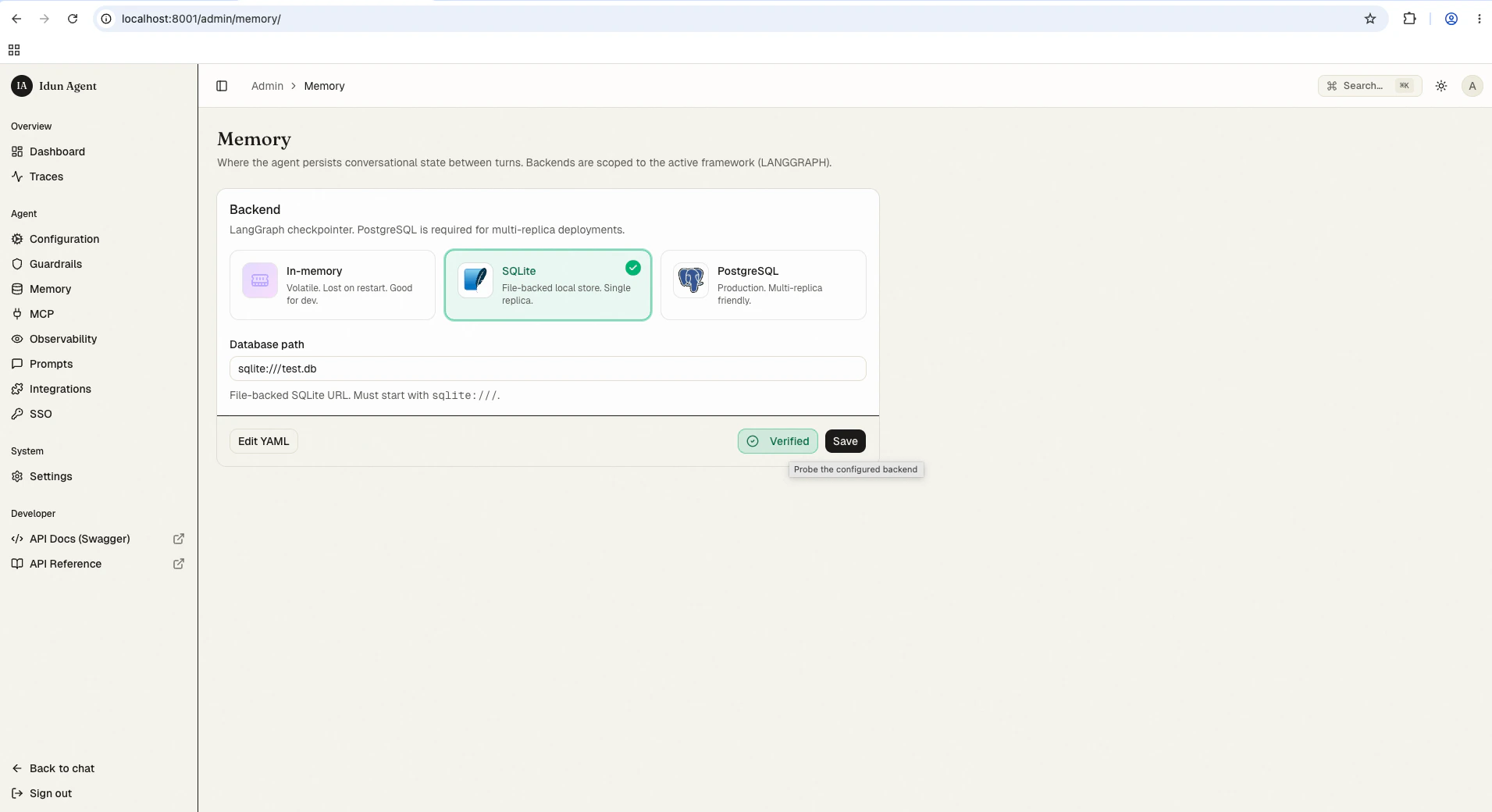
/admin/memory/ in the running standalone. The catalog shows the supported backends: SQLite, PostgreSQL, In Memory, Vertex AI, and Database (ADK-only).2
Configure the backend
Click the backend you want and fill in the connection details. Save; the reload pipeline re-instantiates the engine with the new checkpointer or session service.
Best practices
- Use in-memory for development: No setup required, fastest iteration
- Use PostgreSQL or Database for production: Multi-process support, reliability, and crash recovery
- Configure thread isolation: Each conversation should have a unique
session_idto prevent state leakage - Monitor storage usage: Long-running conversations can accumulate significant state over time
Next steps
LangGraph memory
Checkpointing for conversation state persistence. Supports in-memory, SQLite, and PostgreSQL backends.
ADK memory
Session services for conversation state and memory services for long-term knowledge storage.